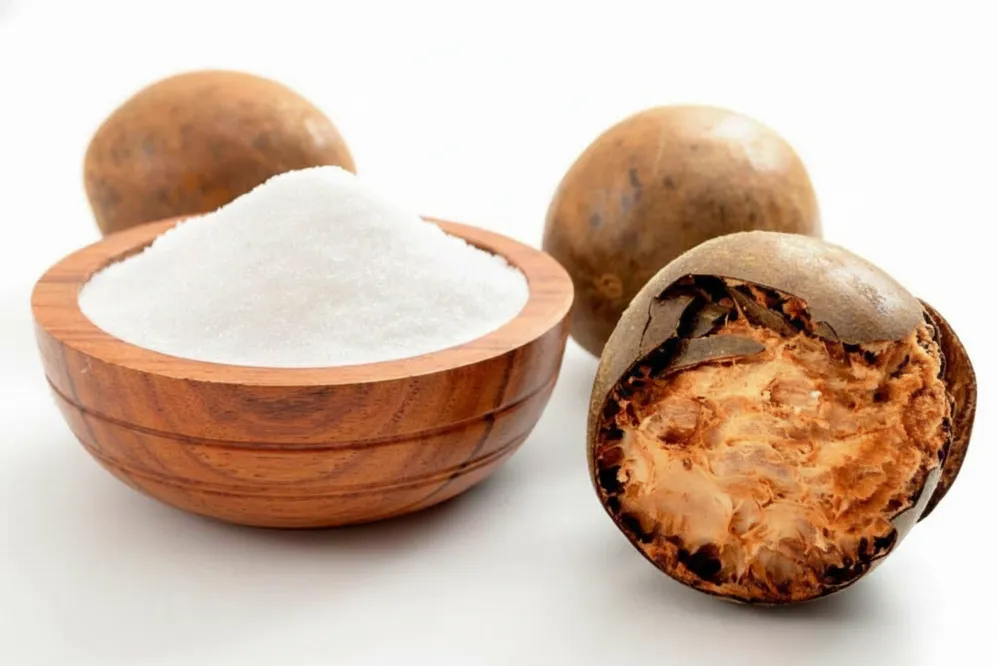

MV20–MV70 are monk fruit extract “grades” standardized by Mogroside V content (e.g., MV50 ≈ ≥50% Mogroside V). Higher MV usually means cleaner taste, lighter color, higher sweetness potency, and higher cost—making MV60–MV70 better for clear beverages and premium “zero sugar” products, while MV20–MV40 often fits cost-sensitive, flavored, or darker applications.
1) What does “MV” mean in monk fruit sweetener grades?
In ingredient trading and formulation, MV is widely used as shorthand for Mogroside V—the main sweet glycoside in monk fruit extract. Regulators and scientific bodies also commonly describe mogrosides as the primary sweet compounds, with mogroside V as the main mogroside in monk fruit extract.
A key FDA GRAS response letter (GRN 000629) describes monk fruit extract specifications as containing ≥20%, ≥25%, ≥30%, ≥40%, ≥50%, ≥55%, ≥60%, etc. mogroside V—which matches how MV grades are marketed (MV20, MV25, MV30…).
Practical takeaway:
- MV20 → typically “~20% Mogroside V (HPLC)” (minimum spec)
- MV50 → “~50% Mogroside V”
- MV70 → “~70% Mogroside V”
(Always confirm with the supplier’s COA and test method.)
2) Why Mogroside V % changes sweetness, taste, and color
Monk fruit sweetness comes from a family of mogrosides, and different mogrosides have different sweetness intensity and taste character. A scientific review of purified mogrosides notes that isolated mogroside V has been reported as ~425× sweeter than sucrose in one study, and that mogrosides differ widely in sensory impact.
But “MV grade” products are not pure mogroside V—they’re standardized extracts. As MV increases, you typically see:
- Higher sweetness potency per gram (so dosage drops)
- Less color (low MV can look yellow/brown; high MV tends to be off-white/white)
- Cleaner sweetness / fewer off-notes (varies by supplier process)
- Higher cost (more purification)
Supplier specification tables commonly reflect this trend. For example, one MV-grade table lists approximate sweetness factors rising from ~80× (MV20) to ~260× (MV70), along with a color shift from darker yellow/brown to milky white.
3) MV20–MV70 grade comparison (what changes and what it means in real products)
Important: Sweetness potency is matrix-dependent (acidity, flavors, temperature, other sweeteners). The numbers below are typical supplier-reported guidance, not universal constants.
Quick comparison table (buyer/formulator-friendly)
| Grade | Mogroside V (typical spec) | Typical “times sweeter than sucrose” (supplier guidance) | Color trend | Taste trend | Best-fit applications |
|---|---|---|---|---|---|
| MV20 | ≥20% | ~80× | Yellow/brown-ish | More “monk fruit” character; can be more noticeable | Herbal/tea drinks, darker sauces, cost-sensitive formulas |
| MV25 | ≥25% | ~100× | Light yellow | Slightly cleaner than MV20 | Flavored beverages, syrups, gummies |
| MV30 | ≥30% | ~120× | Light yellow to off-white | Common “entry” high-intensity grade | RTD tea/coffee, nutrition, general sugar reduction |
| MV40 | ≥40% | ~160× | Off-white/white | Cleaner, less color | Dairy, flavored waters (not ultra-clear), bakery blends |
| MV50 | ≥50% | ~200× | White | Popular “clean taste” grade | Zero-sugar beverages, protein powders, tabletop blends |
| MV60 | ≥60% | ~220–240× (varies by table) | White/milky white | Cleaner, lower dosage | Clear beverages, premium formulations |
| MV70 | ≥70% | ~260× | Milky white | Highest “mainstream” purity tier in MV20–MV70 | Clear beverages, delicate flavors, “premium” clean-label |
A separate but related reality: Many products sold as “monk fruit sweetener” to consumers are blends (e.g., monk fruit + erythritol) to achieve 1:1 sugar replacement. MV grades are typically the high-intensity component inside those blends.
4) Application guide: which MV grade to use (MV20 vs MV50 vs MV70)
A) Clear beverages (sparkling water, soda, sports drinks, flavored water)
Best picks: MV50–MV70
Why: low dosage + cleaner flavor + less color; better for delicate citrus and “clear” flavor systems.
Formulation tip: Monk fruit extract is often positioned as stable across a broad pH/temperature range by suppliers, making it suitable for beverages (always validate in your system).
B) Tea, herbal drinks, traditional flavors (where a slight monk-fruit note is acceptable)
Best picks: MV20–MV40
Why: cost advantage; the natural fruit character can “fit” tea/herbal profiles.
C) Dairy (yogurt, flavored milk, ice cream, whey/protein RTD)
Best picks: MV40–MV60
Why: a balance of clean sweetness and cost; works well in heavier flavor matrices.
D) Baking (cookies, cakes, bars) — what MV can and can’t do
Best picks: MV30–MV50 (usually in a blend)
Reality check: MV grades provide sweetness, but sugar provides bulk, browning, moisture retention, and structure—so most baked applications require bulking agents (erythritol, allulose, fibers, maltitol, etc.) or recipe redesign.
E) Sauces & condiments (ketchup, BBQ, dressings)
Best picks: MV20–MV40 (often)
Why: strong flavors and darker color can tolerate lower MV; good value.
F) Tablets / gummies / supplements
Best picks: MV50–MV70
Why: tiny dosage helps keep tablets small; cleaner taste matters in chewables.
5) Dosage math (simple calculator) + why “times sweeter” can mislead
A quick first-pass estimate:
Monk fruit extract dose (g) ≈ Sugar to replace (g) ÷ Sweetness factor
Example: Replace 100 g sugar using MV50 (~200× supplier guidance)
→ 100 ÷ 200 = 0.5 g MV50 (sweetness only)
But:
- Sweetness is not linear across all concentrations/flavor systems.
- Many supplier pages describe monk fruit extracts broadly as ~200–300× sweeter than sugar depending on grade and standardization.
- You still need to replace sugar’s bulk and texture in most foods.
Use this math for sweetness targeting, then finalize with sensory panels.
6) “MV grade” shopping checklist (avoid expensive mistakes)
When buying MV20–MV70 monk fruit extract powder, ask for:
- COA showing Mogroside V % (HPLC) (and ideally total mogrosides)
- Color/appearance spec (white vs yellow matters in clear drinks)
- Solubility guidance (pre-dissolve instructions can help prevent specks)
- Residual solvents & processing aids (some processes use resins/ethanol in extraction; compliance matters by market)
- Heavy metals & micro limits (especially for supplements)
- Regulatory positioning by geography
7) (Geographic / regulatory) notes: US vs EU/UK
United States
Monk fruit ingredients have been reviewed under the GRAS notice system. For example, FDA GRAS correspondence describes monk fruit extracts standardized across multiple mogroside V levels (including ≥20% through higher tiers).
Canada (helpful reference point)
Health Canada’s consultation on monk fruit extract notes the ingredient is produced via water extraction/filtration/selective concentration and references an FCC monograph specification that monk fruit extract contains no less than 30% mogroside V—which aligns with why MV30 is often considered a “core” commercial grade.
EU / UK (where people often get confused)
EU/UK discussions distinguish monk fruit decoctions (non-selective aqueous preparations) from high-intensity monk fruit extracts (selectively concentrated mogrosides like MV50+). Trade reporting notes decoctions have moved toward broader acceptance, while concentrated extract sweeteners have historically faced barriers.
A 2025 peer-reviewed overview reports that, as of October 2024, the EU authorized only a specific aqueous extract under Regulation (EU) 2024/2345, while highly purified mogrosides/non-aqueous extracts remain unapproved—which is especially relevant if you plan to sell MV50–MV70 products into the EU.
8) FAQ
Is MV50 monk fruit extract better than MV20?
“Better” depends on the product. MV50 is typically chosen for cleaner taste, lighter color, and lower dosage, especially in clear beverages. MV20 is often chosen for cost-sensitive products or where color/flavor can be masked.
What’s the difference between Mogroside V % and “total mogrosides”?
- Mogroside V %: the key standardized sweet compound used for MV grading.
- Total mogrosides %: broader measure of multiple mogrosides; can influence taste and potency.
Can I use MV70 as a 1:1 sugar replacement?
Not by itself. MV70 is high intensity; you’ll need a bulking ingredient for volume/texture in most foods.
Why do sweetness numbers vary between suppliers?
Because:
- “Times sweeter” is measured under different sensory protocols
- Extract composition and minor components differ
- Food matrix effects shift perceived sweetness
Supplier tables commonly provide relative sweetness guidance, not universal constants.